What If You Could Speak With Hidden Parts of Your Own Mind?
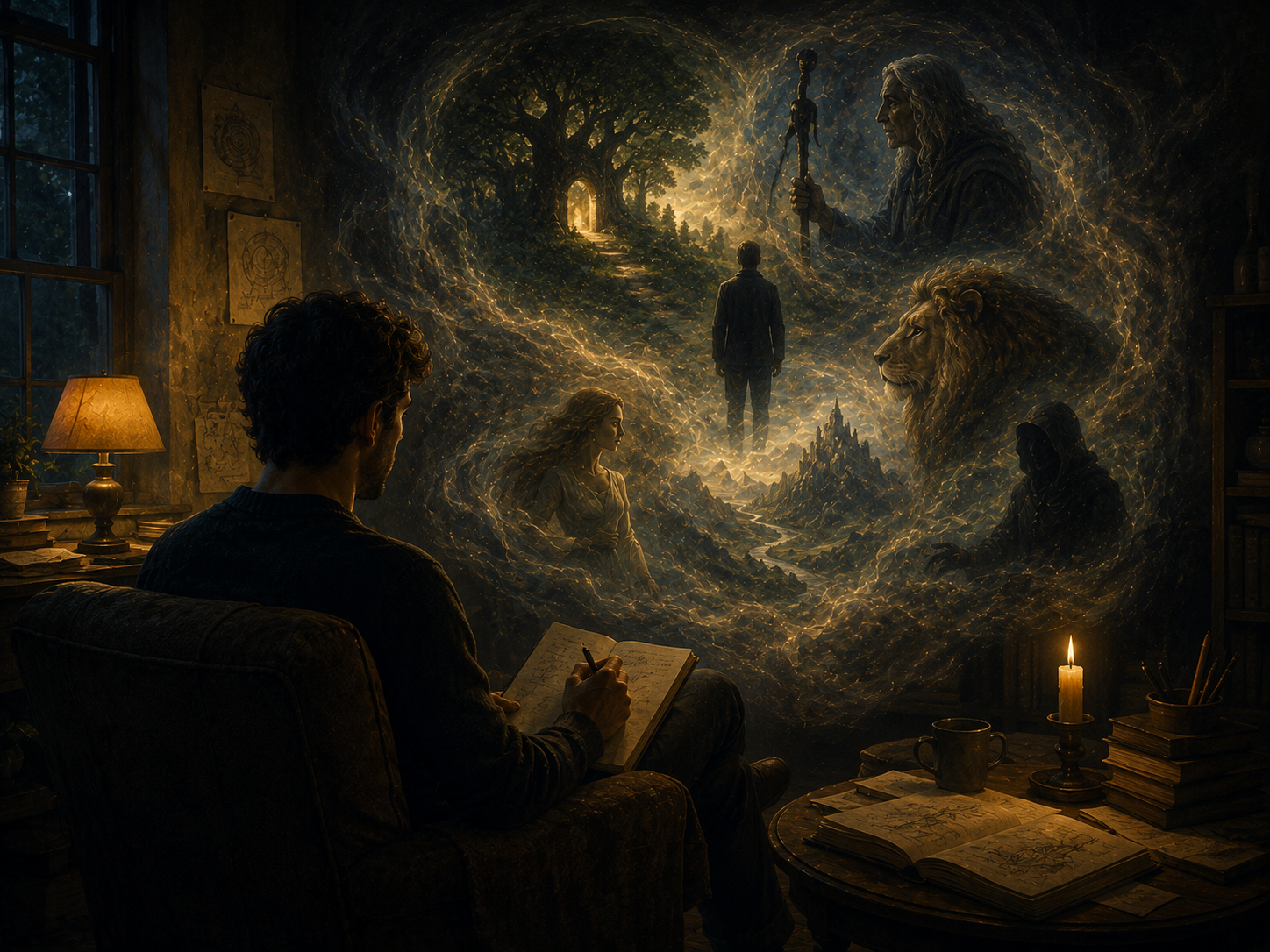
At first glance, the idea may sound unusual, perhaps even a little absurd. Imagine closing your eyes and seeing a figure emerge before you: an old wise man, a child, a warrior, a stranger, or perhaps a dark and unsettling presence that seems strangely familiar. Now imagine beginning a conversation with that figure, asking who it is, why it has appeared, and what it might be trying to communicate.
For many people, this scenario resembles something drawn from mythology, literature, or fantasy fiction. For Carl Gustav Jung, however, such encounters represented one of the most profound ways of exploring the unconscious mind. He believed that the psyche communicates not only through thoughts and concepts, but also through symbols, images, narratives, and emotional experiences that often escape rational understanding.
Jung called this method active imagination, and to this day it remains one of his most fascinating, influential, and controversial psychological techniques.
What Is Active Imagination?
Active imagination is a psychological practice developed by Jung to establish a conscious dialogue with unconscious contents. Rather than passively observing thoughts, memories, dreams, or symbolic images as they arise, the individual actively engages with them, allowing an inner exchange to unfold while maintaining conscious awareness.
The objective is not to invent random fantasies, create fictional characters, or lose contact with reality. Instead, active imagination seeks to provide a structured way of encountering psychological material that usually remains hidden beneath the surface of conscious experience.
Jung believed that many important dimensions of the psyche do not communicate through logical arguments or abstract ideas. Instead, they express themselves symbolically through images, stories, archetypes, emotions, and recurring motifs that emerge spontaneously within the imagination.
In this sense, active imagination can be understood as an attempt to bridge the gap between consciousness and the unconscious, creating a space in which these different dimensions of the mind may interact.
How Did Jung Develop the Idea of Active Imagination?
The origins of active imagination can be traced back to one of the most difficult periods in Jung’s life.
Following his famous separation from Sigmund Freud, Jung entered a prolonged phase of intense introspection, psychological uncertainty, and personal transformation. During these years, he devoted himself to recording dreams, visions, symbolic experiences, fantasies, and inner dialogues, attempting to understand the meaning behind the images that continuously emerged from his unconscious.
These explorations would later become the foundation of many of his most important theories, including his ideas about archetypes, individuation, and the collective unconscious.
For Jung, the unconscious was never merely a repository for repressed memories or forgotten experiences. He increasingly came to view it as a dynamic and living dimension of the psyche, capable of communicating with consciousness through symbolic forms that carry psychological significance.
Active imagination emerged directly from this understanding.
How Does Active Imagination Work?
Although the practice can take several forms, its fundamental principle is relatively straightforward.
A person begins by focusing attention on an image, emotion, dream figure, symbol, or inner experience that arises spontaneously. Rather than dismissing it, suppressing it, or immediately interpreting its meaning, the individual allows the image to evolve naturally.
At that point, a dialogue may begin.
Someone encountering an unfamiliar figure within the imagination might ask:
- Who are you?
- Why have you appeared?
- What do you represent?
- What are you trying to communicate?
- What do you want me to understand?
The essential aspect of the process is that the image is allowed to reveal itself gradually rather than being forced into a predetermined interpretation.
According to Jung, the value of active imagination lies precisely in its openness to surprise, ambiguity, and the emergence of material that challenges conscious expectations.
Does Active Imagination Mean There Are Characters Living Inside Your Mind?
No, and this is perhaps one of the most common misunderstandings surrounding the technique.
Jung was not suggesting that literal personalities inhabit the human mind, nor was he proposing that individuals communicate with independent entities existing somewhere within consciousness.
The process is fundamentally symbolic.
The figures encountered during active imagination may represent aspects of personality, unresolved conflicts, fears, desires, emotional patterns, unrealized potential, or psychological tendencies that have not yet been fully integrated into conscious life.
The dialogue is therefore not with an actual being.
It is a dialogue with psychological material expressed through symbolic imagery.
Understanding this distinction is essential because it allows active imagination to remain grounded within a psychological framework rather than drifting toward mystical or literal interpretations.
What Is the Purpose of Active Imagination?
At its core, active imagination seeks to make unconscious material conscious.
In practical terms, the goal is to bring hidden dimensions of the psyche into awareness, allowing individuals to engage more directly with emotional conflicts, internal tensions, aspirations, and unresolved experiences.
Jung believed that many psychological difficulties persist because important contents remain excluded from conscious understanding. By giving these contents symbolic form and allowing them to emerge within imagination, people may develop a deeper relationship with aspects of themselves that would otherwise remain inaccessible.
For Jung, this process formed an important part of what he called individuation, the lifelong movement toward greater psychological integration and self-understanding.
Why Is Active Imagination So Controversial?
Active imagination occupies a unique place within analytical psychology because it continues to provoke both fascination and skepticism.
Even among Jungian thinkers, an important question frequently arises:
How can we distinguish genuine psychological insight from pure fantasy?
If an inner figure simply tells us exactly what we already believe, or merely confirms our existing assumptions, are we truly encountering unconscious material, or are we simply creating an elaborate conversation with ourselves?
This criticism remains entirely legitimate and continues to be debated today.
Some critics argue that active imagination risks encouraging excessive subjectivity, while others see it as a valuable method for accessing dimensions of human experience that are often overlooked by more exclusively rational approaches.
What Would Jung Say About This Criticism?
Jung would likely argue that active imagination loses much of its psychological value when it becomes entirely controlled by conscious intention.
If we create characters solely to reinforce our preferred narratives, validate our beliefs, or provide comforting answers, then no authentic dialogue is taking place.
There is only a sophisticated monologue.
For Jung, active imagination becomes meaningful precisely when unexpected, uncomfortable, challenging, or surprising material begins to emerge. The unconscious reveals itself most clearly when it resists our attempts to direct it completely.
Paradoxically, what gives active imagination its potential depth is the degree to which it confronts us with perspectives we might not consciously choose for ourselves.
Does Active Imagination Exist Only Within the Mind?
This question introduces an especially intriguing dimension of Jung’s ideas.
Although active imagination is often described as an inner dialogue, many thinkers have suggested that symbolic material also exists outside us, embedded within culture itself.
We encounter symbols in:
- Art
- Literature
- Music
- Mythology
- Philosophy
- Religious traditions
- Humanity’s most enduring stories
These cultural creations provide symbolic resources capable of stimulating profound reflection and enriching psychological life.
Rather than engaging exclusively with spontaneous images arising from within, individuals may also encounter symbols through works of art, novels, myths, and creative traditions that have shaped human experience for centuries.
Can Art Nourish the Imagination?
This question moves beyond psychology and enters the territory of philosophy, aesthetics, and cultural reflection.
Every imagination requires raw material from which it can construct meaning. That material may originate in dreams, memories, emotions, personal experiences, relationships, artistic creations, mythology, or literature.
Yet an important question remains:
Are all symbolic sources equally valuable?
Some thinkers would argue that great works of art do far more than stimulate imagination. They contribute to the formation of the individual who imagines.
A remarkable novel offers more than symbolic content.
It offers a richer way of perceiving reality itself.
Music can deepen emotional sensitivity. Literature can expand our understanding of human complexity. Mythology can provide symbolic frameworks through which personal struggles become more intelligible.
In this sense, imagination is not only something we possess.
It is also something we cultivate.
What Can We Learn From Active Imagination?
Even for those who remain skeptical of Jung’s method, active imagination points toward an important psychological truth.
Human beings do not live by logic alone.
Dreams, symbols, narratives, images, emotions, and fantasies constitute an essential dimension of human existence. Ignoring these experiences entirely may prevent us from understanding significant aspects of ourselves.
At the same time, accepting every symbolic image uncritically can be equally problematic.
Perhaps wisdom lies somewhere between these two extremes.
Neither rejecting symbols outright nor surrendering ourselves completely to them.
Instead, active imagination may invite us to engage with the symbolic dimensions of life thoughtfully, critically, and creatively.
Final Thoughts
Active imagination remains one of Carl Jung’s most original, influential, and controversial contributions to psychology.
For some individuals, it represents a powerful method of self-exploration capable of revealing hidden dimensions of the psyche. For others, it approaches the boundaries between psychological inquiry and fantasy in ways that continue to inspire debate.
Regardless of where one stands, the concept encourages us to consider a profound possibility: there may be far more occurring within the human mind than conscious awareness allows us to perceive.
Perhaps psychological maturity involves learning to listen carefully to these inner voices, symbolic images, and emotional narratives without ever losing our connection to reality.
After all, understanding ourselves is not simply about examining what we think.
It is also about learning to pay attention to the stories through which we understand who we are.
Leave a Reply