
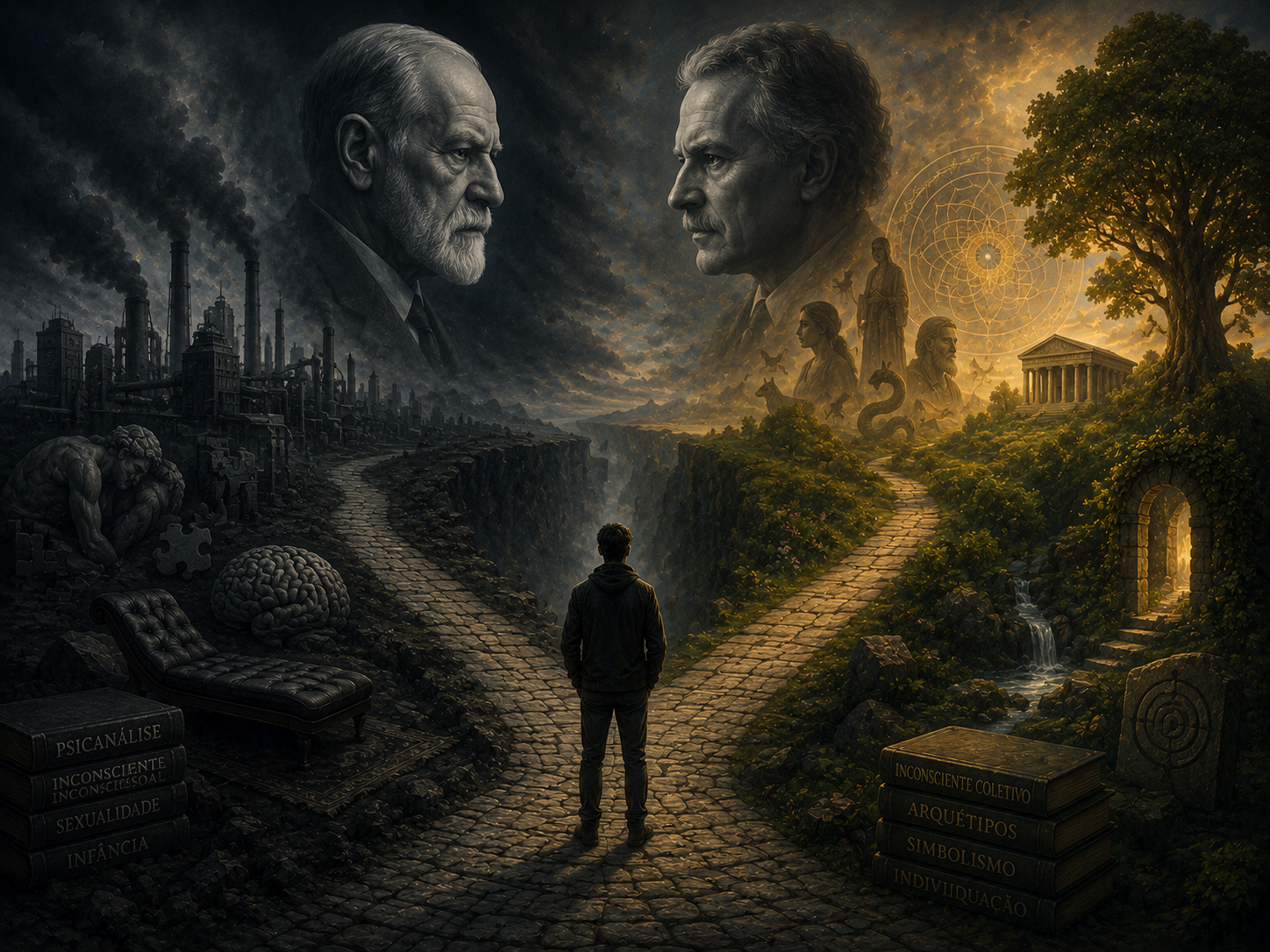
The Friendship That Changed the History of Psychology
Few intellectual relationships have had a greater impact on modern psychology than the one between Sigmund Freud and Carl Gustav Jung. For several years, Jung was widely regarded as Freud’s natural successor, a brilliant young psychiatrist capable of carrying psychoanalysis into the future. Freud admired Jung’s intelligence, originality, and clinical insight, while Jung deeply respected Freud’s revolutionary attempt to uncover the hidden mechanisms of the human mind.
They exchanged hundreds of letters, debated psychological theories, and shared the conviction that they were exploring territories that previous generations had barely begun to understand. At the time, their collaboration appeared destined to reshape psychology for decades to come.
Yet beneath this mutual admiration lay profound philosophical and psychological differences. As their ideas evolved, disagreements concerning human motivation, religion, symbolism, and the nature of the unconscious became increasingly difficult to reconcile. Eventually, these tensions culminated in one of the most famous intellectual separations in modern history, giving rise to two remarkably different visions of human nature.
More than a century later, the debate between Freud and Jung continues to fascinate psychologists, scholars, and readers seeking to understand the complexities of the human psyche.
Who Were Freud and Jung?
Sigmund Freud is widely recognized as the founder of psychoanalysis and one of the most influential thinkers of the twentieth century. His work introduced concepts that continue to shape psychology today, including:
- The unconscious
- Repression
- Transference
- Defense mechanisms
- Infantile development
- Psychic conflict
Carl Jung, initially one of Freud’s closest collaborators, was considered by many to be the ideal candidate to extend and refine psychoanalytic theory. However, Jung’s intellectual interests reached far beyond traditional psychoanalysis.
He immersed himself in mythology, comparative religion, philosophy, symbolism, anthropology, alchemy, and the study of cultural narratives, gradually developing ideas that would eventually form the basis of analytical psychology.
Over time, these differences became impossible to ignore.
Where Did Freud and Jung Agree?
Despite the famous split that divided them, Freud and Jung shared far more common ground than many people realize.
Both Believed in the Unconscious
Perhaps their most significant point of agreement concerned the existence of the unconscious mind.
Both Freud and Jung argued that much of human psychological life unfolds beyond conscious awareness. Thoughts, emotions, desires, fears, memories, and conflicts may exert a powerful influence over behavior even when individuals remain entirely unaware of their presence.
Today, this notion appears almost self-evident.
At the beginning of the twentieth century, however, it represented a genuinely revolutionary perspective.
Both Considered Dreams Psychologically Meaningful
Freud and Jung also agreed that dreams deserved serious attention.
For both thinkers, dreams provided privileged access to dimensions of the mind that remain hidden during ordinary waking consciousness. Although they proposed different methods of interpretation, neither regarded dreams as meaningless mental noise.
Instead, both considered them important sources of psychological insight.
Both Believed the Past Continues to Shape the Present
Another major point of agreement involved the lasting influence of personal history.
Freud and Jung recognized that childhood experiences, family dynamics, emotional wounds, and formative relationships play an essential role in shaping personality throughout life.
Neither believed that individuals emerge into adulthood untouched by their experiences.
The past, in their view, remains active within the present.
Where Did Freud and Jung Begin to Disagree?
The fundamental disagreements between Freud and Jung emerged when they attempted to answer a deceptively simple question:
What exactly exists within the unconscious?
It was at this point that their intellectual paths began to diverge in increasingly significant ways.
The First Major Disagreement: Libido
Freud’s Understanding of Libido
Freud primarily understood libido as sexual energy.
This did not mean sexuality in a narrow or purely biological sense. Rather, Freud considered libido to be a broad form of psychic investment associated with desire, attachment, emotional intensity, and interpersonal relationships.
He believed that many aspects of human behavior could ultimately be traced back to sexual conflicts, wishes, and developmental experiences.
Jung’s Understanding of Libido
Jung regarded Freud’s interpretation as excessively restrictive.
For Jung, libido represented a more general form of psychic energy capable of expressing itself in many different domains of human experience, including:
- Religion
- Art
- Creativity
- Philosophy
- Ambition
- Meaning
- Spirituality
- Love
- Intellectual pursuits
Jung believed that human beings cannot be understood solely through the lens of sexuality.
People also seek purpose, transcendence, self-expression, symbolic understanding, and personal fulfillment.
This broader conception of psychic energy became one of the defining features of analytical psychology.
The Second Major Disagreement: The Structure of the Unconscious
Freud’s View of the Unconscious
Freud largely viewed the unconscious as a repository of repressed memories, forbidden desires, unresolved conflicts, and emotionally charged experiences excluded from awareness.
From this perspective, therapy aimed to bring hidden material into consciousness, allowing individuals to gain insight into the forces influencing their behavior.
Jung’s View of the Unconscious
Jung accepted Freud’s idea of a personal unconscious but argued that it represented only part of the picture.
He proposed the existence of a deeper and more universal psychological layer that he called the collective unconscious.
According to Jung, all human beings share inherited psychological structures that manifest themselves through:
- Myths
- Religious traditions
- Dreams
- Symbolic images
- Folklore
- Cultural narratives
This idea eventually led to one of Jung’s most famous contributions to psychology: the theory of archetypes.
Figures such as the Hero, the Mother, the Wise Old Man, and the Shadow were understood as recurring symbolic patterns appearing across cultures and historical periods.
The Third Major Disagreement: The Goal of Therapy
Freud’s Therapeutic Aim
Freud was primarily concerned with alleviating psychological suffering and helping individuals function more effectively within reality.
His therapeutic project focused on identifying unconscious conflicts and reducing the symptoms associated with neurosis.
In many ways, Freud asked:
What hidden conflicts explain your suffering?
Jung’s Therapeutic Aim
Jung pursued a broader vision.
For him, psychotherapy was not limited to symptom reduction.
Its deeper purpose involved facilitating the development of the whole personality and supporting an individual’s movement toward greater psychological integration.
He referred to this lifelong process as individuation.
The central question therefore shifted from: “How can suffering be reduced?”
To: “Who might I become?”
This distinction illustrates perhaps the most profound difference between Freud and Jung.
Freud concentrated on understanding the origins of distress.
Jung sought to understand the possibilities of human development.
Religion: Another Important Difference Between Freud and Jung
Religion occupied remarkably different places within their theories.
Freud generally approached religion with skepticism, often interpreting religious belief as a psychological response to anxiety, helplessness, and existential vulnerability. In several of his writings, he suggested that religion functioned as a collective attempt to cope with uncertainty and fear.
Jung adopted a significantly different perspective.
Although he did not advocate any particular religious tradition, he believed that religious symbols possess genuine psychological significance and may express profound dimensions of human experience.
For Jung, spirituality was not necessarily a sign of illusion.
It could represent an important aspect of psychological life and personal meaning.
Who Was Right?
This question is frequently asked.
Perhaps, however, it is not the most productive one.
Freud and Jung were attempting to understand an extraordinarily complex reality, and each illuminated dimensions of human experience that the other sometimes neglected.
In certain respects, Jung expanded Freud’s ideas.
In others, he departed from them entirely.
Contemporary psychology continues to bear the influence of both thinkers, and many concepts that have entered everyday language originated from their work.
Even individuals who have never studied psychoanalysis often use terms such as repression, projection, archetype, or unconscious motivation without realizing their historical origins.
What Can We Learn From Their Disagreement?
Perhaps the most enduring lesson offered by the Freud-Jung debate is that human beings may simply be too complex to fit comfortably within a single explanatory framework.
Freud reminds us that hidden conflicts, personal history, unconscious desires, and early experiences matter profoundly.
Jung reminds us that meaning, symbolism, creativity, spirituality, and personal growth are equally important dimensions of human existence.
Rather than viewing Freud and Jung as irreconcilable opponents, it may be more accurate to see them as explorers investigating different regions of the same psychological landscape.
Each provides insights into aspects of the human condition that remain relevant more than a century later.
Final Thoughts
The separation between Freud and Jung was far more than a personal disagreement.
It represented a decisive turning point in the history of psychology and gave rise to two influential traditions that continue to shape contemporary discussions about mind, identity, and human development.
They agreed about the existence of the unconscious, the importance of dreams, and the enduring influence of the past.
Yet they profoundly disagreed about the nature of psychic energy, the structure of the unconscious, the significance of religion, and the ultimate purpose of psychotherapy.
Freud asked: What hidden conflicts explain your suffering?
Jung asked: Who could you become?
Perhaps modern psychology is still attempting to answer both questions simultaneously.
Leave a Reply