
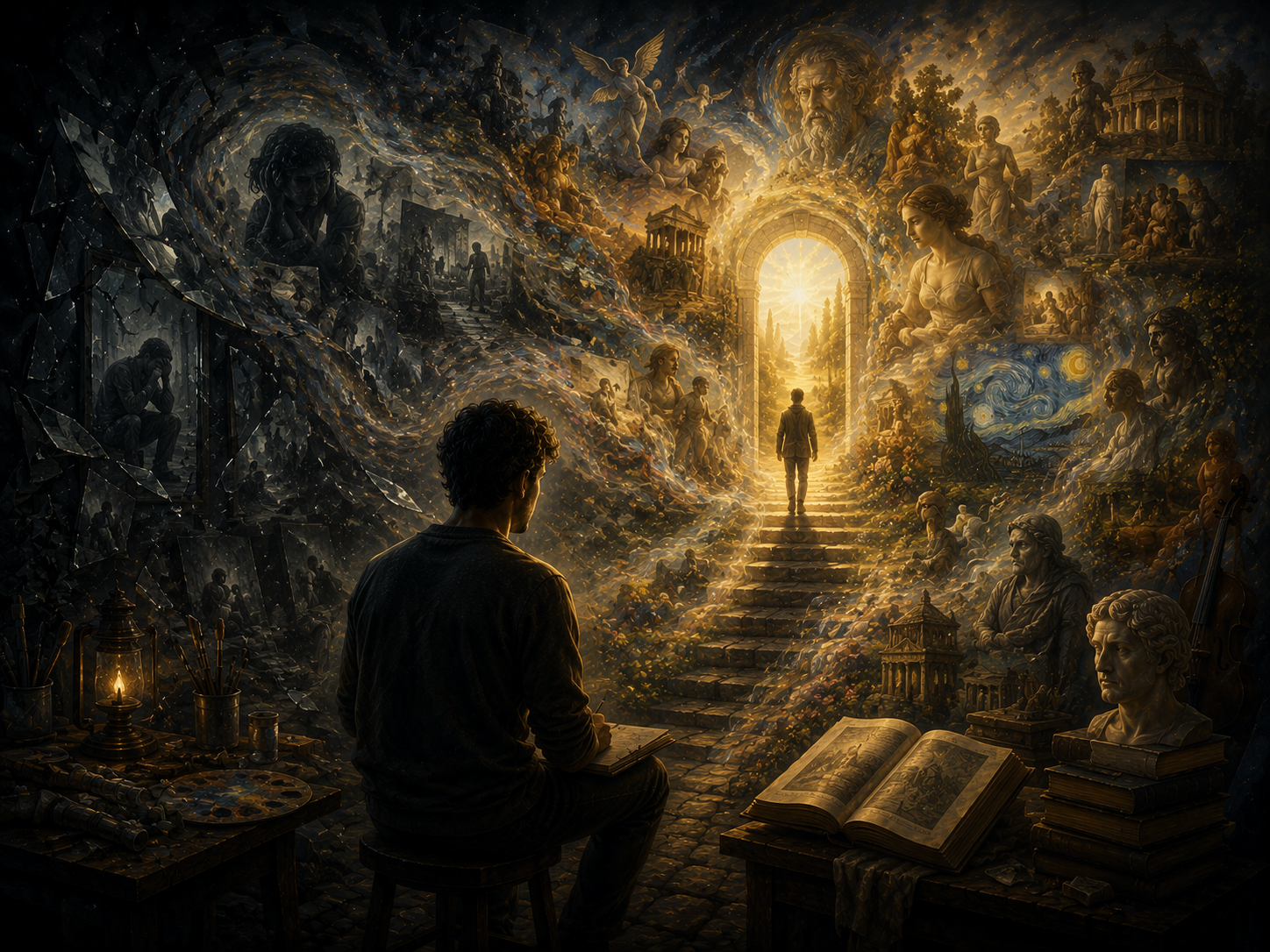
Does Everything We Consume Quietly Shape Who We Become?
Few ideas seem more intuitively true than the belief that the stories we encounter, the books we cherish, the music we replay endlessly, and the films that linger in our memory long after the credits roll leave some kind of imprint upon us. Most people accept this almost instinctively, recognizing that culture influences emotions, molds tastes, inspires aspirations, and even alters the way we interpret reality itself. Yet beneath this seemingly obvious observation lies a far deeper and far more provocative question, one that sits at the crossroads of psychology, philosophy, aesthetics, and human development: do all influences possess the same formative power, or are certain works capable of shaping personality in ways that others simply cannot?
Does a great novel affect us in the same way as disposable entertainment designed to be consumed and forgotten within hours? Can a symphony refine our emotional world differently from a soundtrack created merely to occupy silence? Is there something psychologically distinctive about engaging with a Shakespearean tragedy, a Dostoevsky novel, a Bach composition, or an ancient Greek drama that has continued to move audiences across centuries, cultures, and civilizations? At first glance, such questions may seem elitist or unnecessarily romantic, but they become surprisingly difficult to dismiss once we stop asking what art entertains us and begin asking what art actually does to us.
The Human Mind Cannot Create in a Vacuum
One of the most overlooked realities of human psychology is that imagination never emerges from nothing. No inner world develops independently, no thought appears entirely on its own, and no personality evolves in isolation from the symbolic material that continuously surrounds it. Human beings do not simply think; they think with images, narratives, memories, experiences, metaphors, ideals, and stories that gradually become woven into the architecture of their inner lives.
Every day, often without realizing it, we absorb material that later influences our judgments, expands or narrows our perception, shapes our emotional vocabulary, and subtly determines what kinds of realities we are capable of imagining. That material may originate in personal experiences, dreams, conversations, literature, cinema, music, religion, mythology, philosophy, or the countless cultural artifacts that populate our everyday existence, but regardless of its source, it eventually becomes part of the symbolic landscape through which we understand ourselves and the world around us.
The imagination, therefore, always depends upon raw material.
But this immediately raises a fascinating question.
Is all raw material equally valuable?
If imagination requires nourishment, can we seriously maintain that all forms of nourishment enrich the psyche in precisely the same way?
What Might Jung Say About Great Art?
Carl Jung would almost certainly begin by emphasizing the extraordinary psychological significance of symbols. Throughout his work, Jung argued repeatedly that myths, dreams, religions, artistic traditions, and enduring cultural narratives reveal dimensions of the psyche that cannot easily be expressed through logic alone, which is precisely why he devoted so much attention to archetypes, mythology, religious symbolism, folklore, and the recurring patterns that seem to emerge across different civilizations despite vast historical and geographical differences.
For Jung, certain images possess a remarkable capacity to endure because they appear to speak to something universal within human experience. Figures such as the Hero, the Mother, the Wise Old Man, the Shadow, the Child, or the King continue to appear in literature, art, mythology, and dreams because they resonate with structures embedded deeply within the human psyche itself.
Seen from this perspective, art becomes much more than entertainment.
It becomes a bridge between consciousness and the unconscious, a symbolic language through which individuals encounter dimensions of themselves that might otherwise remain dormant, neglected, or entirely inaccessible.
Yet even if we accept that art possesses this kind of psychological importance, another question quickly emerges.
Does All Art Nourish the Psyche in the Same Way?
This is where the discussion becomes genuinely compelling.
Contemporary culture often prefers to treat all artistic expression as equally legitimate, equally meaningful, and equally valuable, suggesting that differences between works are merely matters of preference rather than matters of excellence. According to this view, one person’s favorite symphony is no more significant than another person’s disposable playlist, and a literary masterpiece differs from fleeting entertainment only in style, not in substance.
But is that conclusion really as self-evident as modern sensibilities would have us believe?
If some works demonstrate greater complexity, greater emotional depth, richer symbolism, more penetrating insight into human suffering, and a more profound understanding of the dilemmas that accompany existence, then an unavoidable possibility begins to emerge.
Perhaps artistic excellence exists.
Perhaps some works genuinely possess a greater capacity to refine sensibility, expand perspective, deepen reflection, and elevate the individual who engages with them.
This is not necessarily a matter of taste.
Nor is it merely an expression of cultural prestige.
Rather, it is a question about consequences.
What kind of person tends to emerge after years spent inhabiting a particular symbolic environment?
Aristotle and the Formation of Character
Aristotle would likely approach this issue from an entirely different direction, although his conclusions may prove surprisingly complementary to Jung’s. For Aristotle, human beings become who they are through repetition, habit, and practice, because character is not something passively inherited but something actively cultivated through countless decisions, experiences, and patterns of attention accumulated over time.
People become courageous by acting courageously.
They become disciplined through repeated acts of discipline.
They become just by practicing justice.
In other words, what we repeatedly do eventually becomes part of who we are.
But if repeated actions shape character, why should repeated symbolic experiences be any different?
Why would years spent engaging with stories centered on sacrifice, beauty, tragedy, responsibility, wisdom, love, loyalty, and virtue not leave a different imprint than years spent immersed exclusively in superficial stimulation, instant gratification, and content designed merely to capture attention for a few fleeting moments?
This does not imply that every artistic experience must be serious, solemn, or intellectually demanding.
Nor does it suggest that entertainment itself is problematic.
It simply acknowledges something modern discussions often hesitate to admit.
Content is not neutral.
The symbolic environment we inhabit participates, however subtly, in the formation of our character.
Art Does More Than Feed the Imagination
Perhaps this is the central insight around which the entire discussion revolves.
We often assume that art exists primarily to stimulate imagination, offering stories, images, and emotional experiences for the mind to process, but perhaps this understanding is incomplete. Perhaps art does not merely provide material for imagination.
Perhaps it transforms the person who imagines.
A truly great work of art offers considerably more than aesthetic pleasure or temporary emotional stimulation. It broadens perspective, refines perception, exposes individuals to experiences they may never personally encounter, confronts them with moral complexity, presents conflicts that resist simplistic solutions, and encourages forms of reflection that extend far beyond entertainment itself.
Great art demands attention.
It cultivates patience.
It challenges assumptions.
It deepens emotional sensitivity.
It complicates simplistic understandings of human nature.
And perhaps most importantly, it reminds us that reality is often richer, stranger, and more profound than our everyday routines allow us to perceive.
In this sense, art does not merely feed the imagination.
It educates the soul that imagines.
Why Quality Matters More Than We Often Admit
This realization inevitably leads toward a somewhat uncomfortable conclusion.
If art possesses formative power, then quality matters.
And it matters immensely.
Because when we choose what to consume, we are not merely selecting entertainment for a free evening or passing time during moments of boredom. We are, knowingly or unknowingly, choosing elements of the symbolic environment that will participate in shaping our perceptions, our sensibilities, our values, and ultimately our understanding of what it means to live a meaningful human life.
This is not an argument for censorship.
Nor is it a defense of elitism.
It is simply an acknowledgment that different forms of content appear to produce different effects, and that those effects may extend much further than immediate pleasure or momentary distraction.
Perhaps the question is not whether one artistic work is objectively superior in every conceivable sense.
Perhaps the more interesting question is this:
What kind of person does this work encourage me to become?
What Does Psychology Have to Say?
Modern psychology increasingly recognizes that narratives influence behavior, that environments shape perception, that role models affect aspiration, and that repeated exposure alters expectations regarding what is desirable, admirable, meaningful, or even normal.
Culture influences identity.
Stories influence identity.
Communities influence identity.
Repeated symbolic experiences influence identity.
This does not mean that art determines personality in a rigid or deterministic manner, because human beings remain capable of interpretation, resistance, and independent judgment. Yet it would be difficult to deny that the symbolic worlds we inhabit contribute significantly to the gradual process through which our personalities continue to develop.
Perhaps culture does not completely determine who we become.
But it almost certainly participates in the process.
Does the Quality of Imagination Depend on the Quality of the Soul?
This question may initially sound unusual, but it deserves serious consideration.
When two individuals encounter the same painting, the same symphony, the same novel, or the same film, they rarely perceive the same reality. Each interprets the work through the lens of personal experience, intellectual maturity, emotional development, moral sensibility, and the unique structure of their own character.
This suggests something fascinating.
Imagination depends not only upon the images we receive.
It also depends upon the person receiving them.
Inner formation shapes interpretation.
Interpretation reshapes inner formation.
And this reciprocal process may continue throughout an entire lifetime.
Final Thoughts
Jung showed us that symbols, myths, and stories exert a profound influence over psychological life because they allow individuals to encounter dimensions of the psyche that rational analysis alone cannot fully access. Aristotle showed us that habits, experiences, and repeated patterns of engagement gradually shape character, influencing not only what we do but also who we become.
When these perspectives are brought together, an intriguing possibility emerges.
Perhaps art is far more than entertainment.
Perhaps it is far more than aesthetic pleasure.
Perhaps it is even more than cultural expression.
Perhaps art participates, in subtle yet powerful ways, in the formation of the person we are becoming.
This does not mean that a single novel, film, painting, or symphony will transform someone overnight. Human development is far too complex for such simplistic conclusions. Yet it may mean that what we repeatedly admire, contemplate, revisit, and allow to inhabit our imagination gradually contributes to the architecture of our inner world.
After all, if we become what we repeatedly do, perhaps we also become, at least in part, what we repeatedly contemplate.
And that leaves us with a question that may be more important than it first appears: What kind of world are you inviting into your mind every single day?
Leave a Reply