
Why Does Carl Jung Continue to Fascinate Millions of People?
More than half a century after his death, Carl Gustav Jung remains one of the most influential, debated, and widely read psychologists in modern intellectual history. His ideas have shaped not only psychology, but also philosophy, literature, religion, art, cinema, and contemporary discussions about identity, meaning, and personal growth.
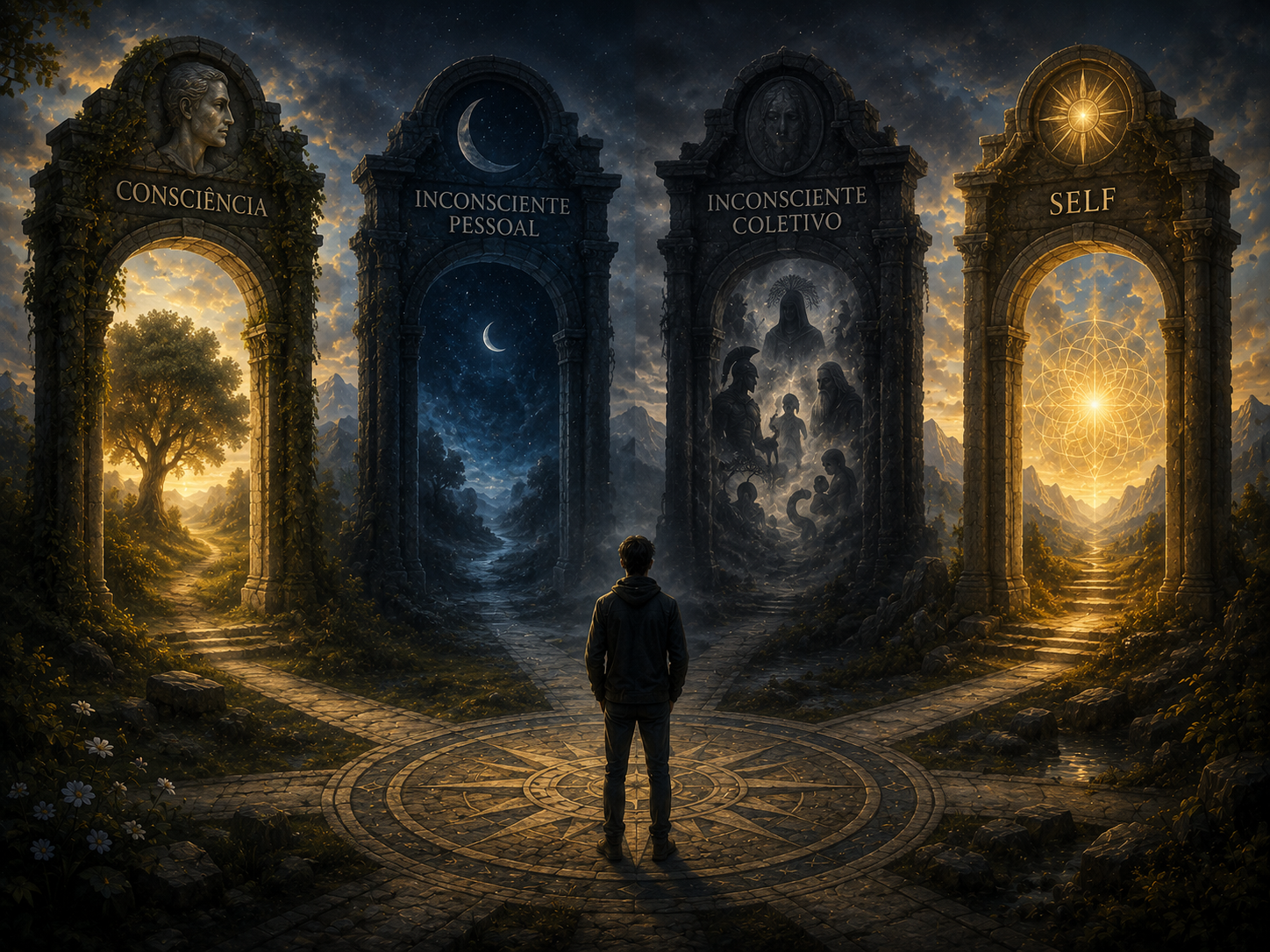
Yet for many newcomers, entering the world of Jungian psychology can feel surprisingly intimidating. Concepts such as the Self, archetypes, the collective unconscious, individuation, and active imagination often appear abstract, complex, and deeply interconnected, making Jung’s work seem like an intricate maze of symbols and unfamiliar terminology.
The encouraging news is that Jung’s psychological system becomes far more accessible when viewed through a handful of fundamental principles. Rather than approaching his theories as isolated ideas, it is often more useful to understand them as parts of a broader framework centered on human development, self-knowledge, and psychological integration.
In this guide, we will explore the four pillars that support much of Jungian psychology and explain why they continue to inspire psychologists, scholars, and curious readers around the world.
What Was Carl Jung Trying to Understand?
Before examining the pillars themselves, it is worth asking a more fundamental question: what was Jung actually trying to understand?
At its core, Jung’s work revolved around a profound and timeless inquiry:
How does a human being become who they truly are?
While many psychological theories focus primarily on symptoms, behavior, adaptation, or pathology, Jung was interested in something broader and arguably more ambitious. He sought to understand the lifelong process through which individuals develop, confront their inner conflicts, discover hidden dimensions of themselves, and gradually move toward greater psychological wholeness.
The four pillars of Jungian psychology emerge directly from this question and together provide a framework for understanding how personal transformation unfolds throughout life.
Pillar 1 — Individuation
The Lifelong Process of Becoming Who You Truly Are
If the entirety of Jungian psychology could be condensed into a single concept, that concept would almost certainly be individuation.
Jung believed that every individual possesses unique psychological potential waiting to be discovered and developed. Human life, in his view, is not solely about survival, social adaptation, or fulfilling external expectations. It also involves an inner journey aimed at becoming the most authentic version of oneself.
He called this process individuation.
Individuation involves:
- Self-knowledge
- Psychological growth
- Integration of inner conflicts
- Recognition of unconscious patterns
- Development of unrealized potential
- Greater harmony between conscious and unconscious aspects of personality
According to Jung, this process never truly ends. There is no moment at which a person can confidently declare that they have become completely finished or fully realized.
Individuation is not a destination.
It is an ongoing dialogue between who we are, who we believe ourselves to be, and who we may yet become.
Pillar 2 — The Analytic Relationship
Why Is Therapy More Than Just a Conversation?
Jung considered the therapeutic relationship one of the most significant elements of psychological development. Rather than viewing therapy as a purely intellectual exercise, he saw it as a genuine encounter between two human beings whose emotional worlds inevitably influence one another.
Within this relationship, two essential processes emerge.
Transference
Transference occurs when patients unconsciously project emotions, expectations, desires, and relational patterns developed in earlier relationships onto the therapist.
Countertransference
Countertransference refers to the emotional responses experienced by the therapist in relation to the patient.
These reactions may include:
- Sympathy
- Irritation
- Concern
- Protectiveness
- Frustration
- Sadness
- Anxiety
- Admiration
Contemporary psychodynamic approaches increasingly recognize these emotional responses as valuable sources of clinical understanding rather than mere obstacles to treatment.
For Jung, therapy was never simply an exchange of information.
It was a meeting between two personalities, each capable of influencing and transforming the other.
Indeed, Jung famously suggested that no meaningful human encounter occurs without some degree of mutual change.
Pillar 3 — Dreams
Understanding the Symbolic Language of the Unconscious
Few subjects are more closely associated with Jung than the interpretation of dreams.
Unlike approaches that dismiss dreams as random neurological activity, Jung believed they possess profound psychological significance. However, he did not regard dreams as supernatural predictions, mystical revelations, or messages from external forces.
Instead, dreams represented symbolic expressions of unconscious processes.
They may reveal:
- Hidden conflicts
- Emotional tensions
- Repressed desires
- Unacknowledged fears
- Neglected aspects of personality
- Emerging possibilities for psychological growth
For Jung, dreams function as a bridge connecting consciousness with dimensions of the psyche that often remain inaccessible during waking life.
This is precisely why he considered dream analysis one of the most important pathways toward understanding the unconscious mind.
Pillar 4 — Active Imagination
Building a Dialogue Between Consciousness and the Unconscious
Among Jung’s many ideas, active imagination remains one of the most original and controversial.
Its central premise is relatively simple.
Rather than merely observing symbolic images as they arise, individuals consciously engage with them.
A figure appears.
An image emerges.
A symbol captures attention.
Instead of suppressing it, dismissing it, or reducing it to an abstract interpretation, the individual allows a dialogue to unfold.
The purpose of active imagination is not fantasy for fantasy’s sake, nor is it an invitation to escape reality. Its objective is to create a space where unconscious material can gradually find conscious expression.
For Jung, this process reduces the distance between:
- Who we believe ourselves to be
- What actually exists within us
Through active imagination, hidden dimensions of the psyche may become more accessible, allowing individuals to establish a richer and more conscious relationship with their inner world.
Where Do Archetypes Fit Into Jungian Psychology?
Many readers are surprised to discover that archetypes do not appear among the four pillars themselves.
The reason is straightforward.
Archetypes permeate every aspect of Jungian psychology.
They emerge within:
- Dreams
- Active imagination
- Transference
- Countertransference
- Individuation
- Symbolic experiences
Figures such as:
- The Hero
- The Mother
- The Wise Old Man
- The Shadow
- The Trickster
- The Child
Represent universal psychological patterns that seem to recur across cultures, civilizations, and historical periods.
Rather than constituting an independent pillar, archetypes function as an underlying structure that supports Jung’s entire psychological framework.
The Ultimate Goal of Jungian Psychology
When examined together, these four pillars reveal a common aspiration.
Jung was never interested solely in reducing symptoms or alleviating psychological distress. His broader ambition was to understand how human beings move toward greater completeness, self-awareness, and inner coherence.
His fundamental question remained remarkably consistent throughout his career:
How can the different dimensions of the psyche be integrated into a more complete and authentic whole?
Individuation provides the overall direction.
The analytic relationship creates a space for exploration.
Dreams offer access to hidden dimensions of experience.
Active imagination establishes a dialogue between consciousness and the unconscious.
Together, these processes support what Jung regarded as the central task of psychological life: the fuller realization of human potential.
Final Thoughts
Jungian psychology is vast, sophisticated, and occasionally challenging, yet understanding its four foundational pillars makes the rest of Jung’s work considerably easier to approach.
Individuation illuminates the path of personal development.
The analytic relationship reveals how transformation occurs through human connection.
Dreams provide access to unconscious processes.
Active imagination creates opportunities for dialogue with dimensions of ourselves that often remain hidden.
Whether one ultimately agrees with all of Jung’s conclusions or not, it is difficult to deny that he was attempting to answer one of humanity’s most enduring and compelling questions:
How do we become who we truly are?
Perhaps this enduring search for meaning, wholeness, and self-understanding explains why Jung’s work continues to resonate so powerfully in the twenty-first century.
Leave a Reply