
Is Self-Knowledge Really Enough?
Few ideas have become as influential in contemporary culture as the pursuit of self-knowledge. Books, podcasts, therapists, social media personalities, and an endless stream of self-improvement literature repeatedly encourage us to look inward, understand ourselves more deeply, and uncover the hidden forces shaping our thoughts, emotions, and decisions, all built upon the assumption that if we can only understand ourselves well enough, we will naturally become happier, wiser, and more fulfilled human beings.
And there are good reasons why this message resonates so strongly.
Understanding our fears, desires, emotional patterns, vulnerabilities, and unconscious motivations can profoundly transform the way we experience the world, relate to others, and make sense of our own lives. Few thinkers dedicated themselves more passionately to this task than Carl Gustav Jung, whose psychological project was, in many respects, an extraordinary attempt to answer one of humanity’s oldest questions: Who are we beneath the masks we wear, the expectations imposed upon us, and the identities we gradually construct throughout our lives?
Yet despite the enormous contemporary emphasis placed on self-discovery, there is a question that surprisingly receives far less attention than it deserves.
Is self-knowledge enough?
Can understanding ourselves truly guarantee that we will live well, flourish, or become better human beings, or is there something essential that remains missing if self-awareness is pursued in isolation?
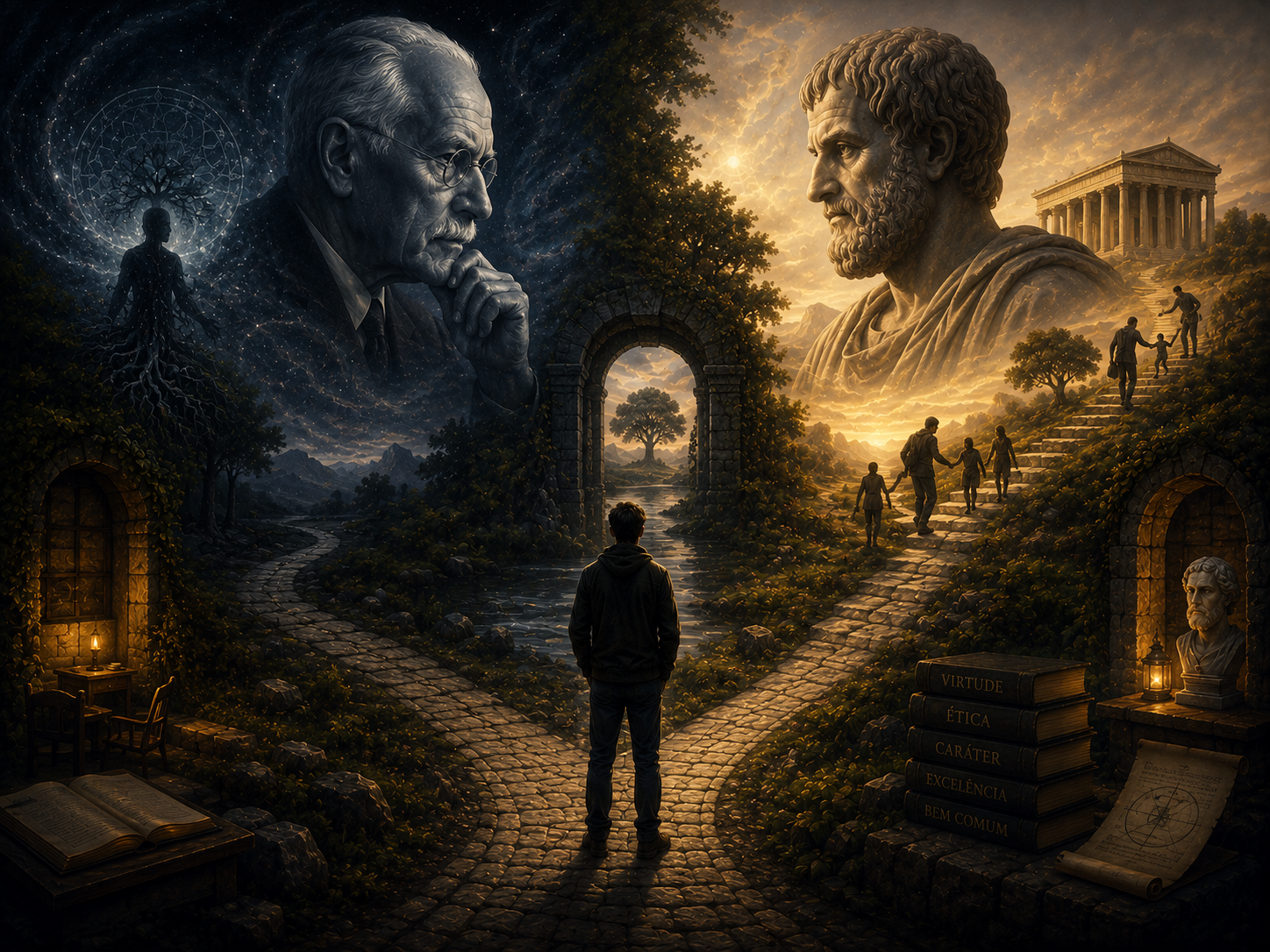
It is precisely here that an unexpected and fascinating dialogue emerges between Jung and Aristotle, two thinkers separated by more than two millennia, yet united by a common concern with one of the most profound and enduring problems of human existence: what does it actually mean to become fully human?
What Was Jung Really Seeking?
If Jung’s entire intellectual legacy could be condensed into a single question, it would probably be this:
Who are you really?
Not who society expects you to be.
Not who your family encouraged you to become.
Not the version of yourself that adapts, performs, and conforms to external demands, but the deeper person that exists beneath conscious awareness, hidden within dreams, symbols, forgotten memories, unrealized possibilities, and dimensions of personality that often remain unexplored for decades.
For Jung, life was never simply a matter of adaptation, productivity, or social success. It was also an inward journey directed toward psychological wholeness, a gradual process through which individuals become increasingly capable of recognizing, integrating, and reconciling the many conflicting aspects that coexist within them.
He called this process individuation.
Individuation is perhaps one of Jung’s most powerful ideas because it suggests that human beings are not finished products, nor are they static entities whose personalities are fixed once adulthood is reached. Instead, each individual possesses latent potential, neglected capacities, and dimensions of the psyche that await discovery, integration, and expression.
The goal, therefore, is not to become someone else.
Nor is it to achieve some abstract ideal imposed from the outside.
Rather, it is to become more completely what one already is in potential.
This is why Jung devoted so much attention to dreams, archetypes, mythology, active imagination, symbolic experience, and the unconscious itself, seeing them not as curiosities or intellectual distractions, but as indispensable tools for uncovering hidden dimensions of the self that modern life often encourages us to ignore.
What Was Aristotle Really Seeking?
Aristotle approached human existence from an entirely different angle.
His fundamental question was not primarily concerned with identity, authenticity, or psychological integration.
He wanted to understand something else.
What are human beings for?
For Aristotle, this was not a strange or abstract question. He believed that everything in nature possesses a purpose, an orientation, or an end toward which it naturally tends. A seed strives toward becoming a tree, birds are ordered toward flight, and living organisms develop according to the kind of being they are.
Human beings, however, occupy a unique position because our distinctive characteristic is not simply existence itself, but our capacity for rationality, reflection, judgment, and virtue.
Aristotle called the fulfillment of this potential eudaimonia, a concept often translated as happiness, although that translation captures only a fraction of its meaning. Eudaimonia is better understood as flourishing, thriving, or living in accordance with what is best and most excellent within human nature.
For Aristotle, the ultimate question was therefore not merely whether we understand ourselves, but whether we are directing our lives toward what is genuinely good.
Where Jung and Aristotle Meet
Despite the centuries separating them, Jung and Aristotle share several surprisingly important assumptions.
Neither believed that human beings are complete from the moment they enter adulthood.
Neither viewed life as a static condition.
Both understood existence as a developmental process, a movement toward the realization of possibilities that remain dormant until they are consciously cultivated.
Yet the questions they ask remain fundamentally different.
Jung asks: Who can you become?
Aristotle asks: What is the best way to become who you can become?
At first glance, the distinction may appear subtle, almost insignificant, but in reality it transforms the entire conversation, because one question is concerned primarily with authenticity and psychological integration, while the other asks whether authenticity alone is enough, or whether human flourishing ultimately requires orientation toward something that transcends individual preference.
This distinction changes everything.
The Great Difference Between Jung and Aristotle
For Jung, the center of psychological development lies in integration.
The challenge is to reduce fragmentation, bring unconscious material into awareness, reconcile conflicting dimensions of personality, and establish a more harmonious relationship between the ego and the deeper structures of the psyche.
Aristotle, however, would almost certainly ask another question.
An uncomfortable question.
Perhaps even a disturbing question.
Toward what end is all this integration directed?
A person may possess extraordinary self-awareness, understand their motivations with remarkable clarity, recognize their fears, integrate inner conflicts, and achieve a degree of psychological coherence that many would admire, yet an unsettling possibility immediately emerges: what if these capacities are placed in the service of questionable goals?
What if someone becomes deeply integrated while remaining profoundly disoriented in moral terms?
What if psychological maturity and moral maturity are not necessarily identical processes?
This possibility deserves serious consideration because it challenges one of the assumptions often embedded within modern discussions of personal growth: the idea that becoming more conscious automatically makes us better.
Aristotle would likely reject this conclusion.
Self-knowledge, in his view, is immensely valuable, but it does not tell us what deserves to be pursued, what ought to be valued, or what kind of person we should aspire to become.
Self-awareness may increase effectiveness.
It may increase coherence.
It may even increase personal freedom.
But none of these things automatically guarantees virtue.
Does Suffering Come From Being Far From Who We Are?
Jung would probably answer yes.
Much human suffering emerges because individuals become alienated from themselves, rejecting emotions, suppressing desires, denying vulnerabilities, and constructing identities that feel increasingly disconnected from their deeper psychological reality.
For Jung, many forms of anxiety, dissatisfaction, and inner conflict arise from fragmentation, from the widening distance between conscious identity and unconscious life.
Yet Aristotle might suggest that another source of suffering exists.
Perhaps suffering also appears when we drift away not merely from who we are, but from what we ought to become.
Perhaps the problem is not only inauthenticity.
Perhaps it is also misdirection.
And once purpose enters the discussion, everything changes.
Because if human beings possess a proper orientation, then not every desire deserves fulfillment, not every form of self-expression represents genuine progress, and not every path leads toward flourishing.
Perhaps the Real Question Is Not Jung or Aristotle
Maybe the most interesting conclusion is that we do not need to choose between them.
Jung offers extraordinary tools for understanding the hidden architecture of the psyche, revealing how unconscious forces shape our behavior, relationships, aspirations, and sense of identity.
Aristotle, meanwhile, reminds us that understanding ourselves may only be the beginning, because once self-knowledge has been achieved, another question inevitably follows:
What should we do with it?
Perhaps a meaningful life requires both perspectives.
Self-knowledge without direction risks becoming endless introspection.
Direction without self-knowledge risks becoming rigidity, conformity, or the pursuit of ideals that have never truly been examined.
Awareness without virtue may lose its compass.
Virtue without awareness may become little more than performance.
Final Thoughts
Jung asked: Who are you really?
Aristotle asked: What are you for?
Perhaps these questions are not rivals competing for our allegiance.
Perhaps they are complementary.
Perhaps they describe two dimensions of the same journey.
Because discovering who we are undoubtedly matters.
But what we choose to do with that knowledge may matter even more.
After all, becoming more conscious and becoming better are not necessarily the same thing, and perhaps one of the greatest challenges of human existence is learning how to pursue both at once.
Leave a Reply