
Are Dreams Really the Best Material for Understanding Ourselves?
When Carl Jung developed the technique of active imagination, he proposed a method that remains one of the most fascinating and debated practices in analytical psychology. His central insight was both simple and revolutionary: instead of dismissing dreams, fantasies, symbolic images, and spontaneous contents emerging from the unconscious, we should engage with them consciously, allowing them to become the starting point for an inner dialogue capable of revealing dimensions of ourselves that ordinarily remain hidden from awareness.
For Jung, these symbolic manifestations were not meaningless mental noise, nor were they random products of imagination detached from psychological reality. They represented potential pathways toward self-knowledge, offering access to fears, desires, conflicts, unrealized possibilities, and aspects of personality that might otherwise remain inaccessible to conscious reflection.
Yet there is an intriguing question that rarely receives sustained attention in discussions about active imagination. If symbols constitute the language through which the psyche communicates with consciousness, are all symbolic sources equally valuable? Can a spontaneous dream offer the same richness as a great literary masterpiece? Can an accidental fantasy nourish the imagination in the same way as centuries of accumulated artistic, philosophical, and cultural wisdom?
This is not an argument against Jung’s method, nor is it an attempt to diminish the importance of dreams and unconscious imagery. Rather, it is an invitation to broaden the conversation, because perhaps the essential question is not merely how we imagine, but also what nourishes our capacity to imagine in the first place.
What Was Jung Trying to Achieve Through Active Imagination?
Before exploring this question, it is important to understand the original purpose of the technique itself. Jung believed that human beings exist within a constant tension between what they consciously know about themselves and what remains concealed beneath the surface of awareness, creating a psychological divide that often generates conflict, fragmentation, and suffering.
Active imagination was conceived as a bridge between these two domains. Through symbolic images, inner dialogues, dreams, and spontaneous psychic contents, individuals could establish a conscious relationship with aspects of themselves that had previously existed only within the unconscious, gradually integrating hidden dimensions of personality into a more coherent understanding of who they are.
The objective, however, was never fantasy for its own sake. Jung was not encouraging individuals to escape reality, indulge in arbitrary imagination, or construct fictional worlds disconnected from ordinary existence. The ultimate goal was understanding, because active imagination was intended to function as a genuine conversation between consciousness and the unconscious, allowing psychological material to emerge, unfold, and reveal meanings that might otherwise remain obscured.
Every Imagination Requires Raw Material
There is, however, an important detail that is rarely emphasized with sufficient depth.
No imagination operates in isolation, and no symbolic activity occurs within a vacuum. Every act of imagination depends upon material that already exists, whether consciously acquired or unconsciously absorbed, because the mind cannot create without first having something from which to create.
That material may arise from dreams, memories, emotions, relationships, personal experiences, myths, stories, books, music, philosophical ideas, religious traditions, or artistic works accumulated over centuries of human history. In other words, before imagination can begin its work, something must first enter the inner world and become available as symbolic substance.
This observation leads us toward an unavoidable question: if imagination always depends upon symbolic material, does all material nourish the psyche equally, or are some forms of symbolic experience inherently richer, deeper, and more capable of promoting genuine self-understanding?
Jung’s Traditional Argument
Jung himself would probably insist that spontaneous psychic material should never be dismissed too quickly. A strange dream, an uncomfortable image, an unexpected fantasy, or an irrational symbolic figure may contain information of extraordinary psychological value precisely because it originates beyond conscious intention.
The unconscious rarely asks permission before expressing itself, nor does it necessarily communicate through elegant narratives, coherent arguments, or aesthetically refined symbols. More often, it emerges through fragments, contradictions, unsettling images, and experiences that we would never consciously choose to create for ourselves.
And there is undeniable wisdom in this perspective.
Some of the most important discoveries we make about ourselves emerge unexpectedly, arriving through symbols that initially appear confusing, irrational, or even disturbing. Dreams often reveal aspects of our inner life that conscious reflection has overlooked, ignored, or deliberately avoided.
Yet acknowledging the importance of dreams does not necessarily imply that dreams represent the highest or most fertile source of symbolic material available to human beings.
Perhaps Great Art Offers Another Path
At this point, another possibility begins to emerge.
Recognizing the value of unconscious imagery does not require us to believe that every symbolic source possesses identical depth, nor does it oblige us to assume that spontaneous material is always the richest material with which imagination can work.
Perhaps certain forms of cultural expression nourish the imagination in ways that are more structured, more refined, and more profound.
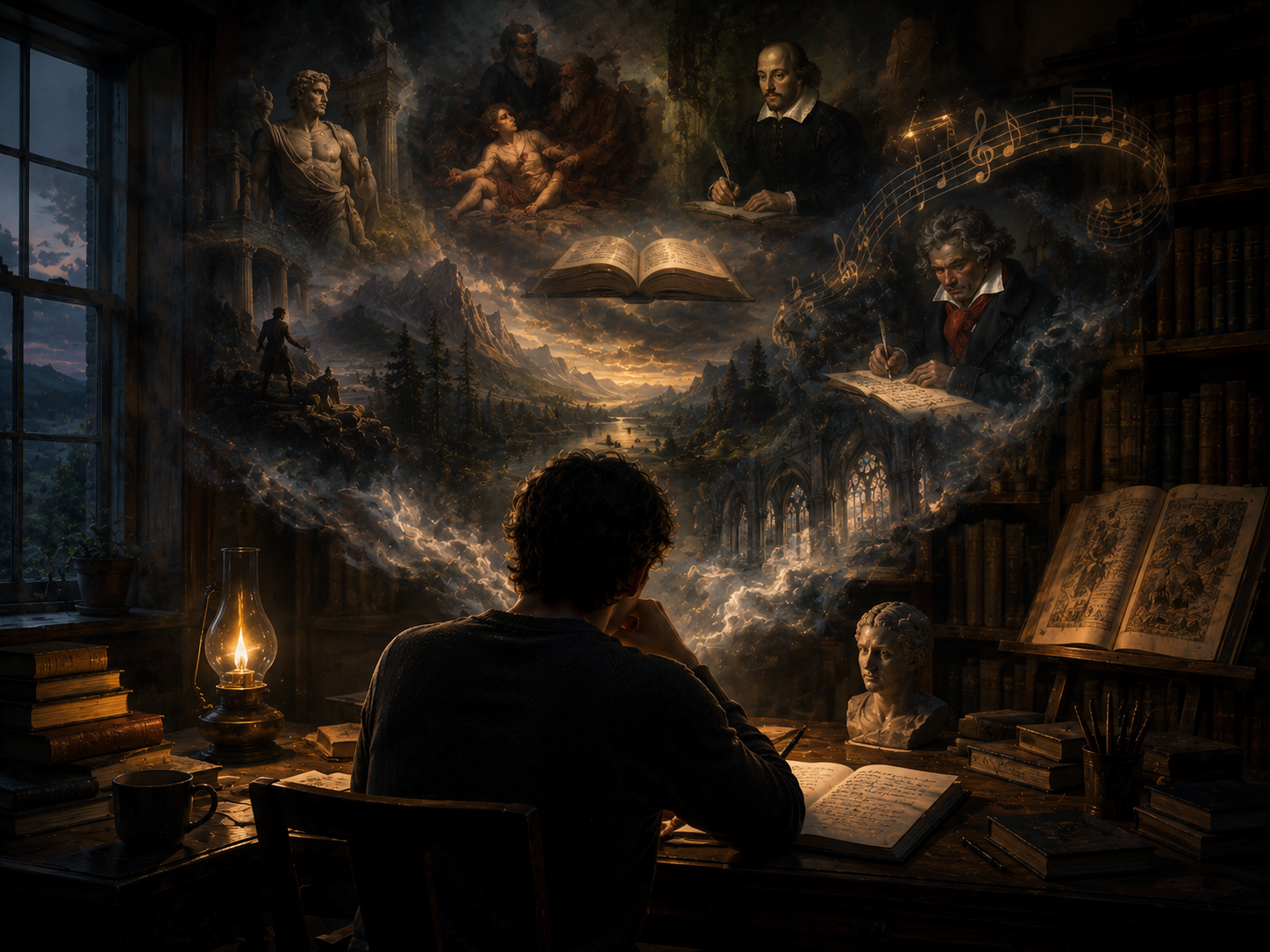
Great novels, classical myths, sacred texts, Greek tragedies, philosophical traditions, and extraordinary works of music did not arise accidentally, nor do they simply reflect isolated emotional experiences. Rather, they represent centuries of accumulated reflection upon suffering, courage, responsibility, sacrifice, love, mortality, meaning, virtue, and the countless dilemmas that define human existence.
In that sense, they may offer imagination something dreams cannot always provide.
Not merely symbolic fragments.
But symbolic worlds.
The Difference Between Discovering and Receiving
Dreams arrive spontaneously.
Great works of art are intentionally crafted.
At first glance, this distinction may seem insignificant, yet it may actually reveal something profoundly important about the relationship between imagination and culture.
Dreams frequently present isolated images, emotional traces, symbolic fragments, and personal narratives whose significance must be patiently uncovered through interpretation. Great art, by contrast, often presents already-formed structures of meaning, narratives that have been refined, explored, and revisited through generations of human experience.
A dream may reveal something deeply personal.
A masterpiece may reveal something personal while simultaneously illuminating something universal.
Dreams often expose individuality.
Great art frequently exposes humanity.
For this reason, perhaps dreams and artistic traditions should not be understood as competing sources of symbolic nourishment, but rather as complementary dimensions of psychological development, each offering access to different aspects of reality.
Art Does More Than Provide Symbols
Here lies the heart of the argument.
When we encounter great literature, profound philosophy, classical music, or enduring artistic achievements, we receive far more than symbolic imagery. We inherit ways of understanding reality, frameworks for interpreting suffering, examples of courage, visions of beauty, reflections upon morality, and possibilities for understanding ourselves that might never emerge through purely spontaneous imagination.
A truly great work of art does not simply enrich imagination.
It refines perception.
It expands sensibility.
It deepens judgment.
And perhaps most importantly, it transforms the person who imagines.
Aristotle Might Have Agreed
Although separated from Jung by more than two millennia, Aristotle would probably have found this line of thought remarkably familiar. For Aristotle, human beings become what they repeatedly contemplate, practice, and admire, because habits, experiences, examples, and environments participate directly in the formation of character.
If this principle applies to actions, there seems little reason to assume it would not also apply to symbolic life.
What we repeatedly expose ourselves to inevitably influences what we consider admirable, meaningful, desirable, and worthy of pursuit. If imagination depends upon symbolic nourishment, then the quality of imagination may depend substantially upon the quality of the material that sustains it.
Just as nourishing food strengthens the body, meaningful cultural experiences may strengthen the inner life.
The Problem of Shallow Symbolic Material
This question becomes especially relevant within contemporary society, where human beings are exposed to an unprecedented quantity of images, narratives, videos, and information competing constantly for attention.
Never before have people consumed so much symbolic material.
Yet abundance should not be confused with depth.
Much of what surrounds us is designed primarily to capture attention, stimulate desire, maintain engagement, and maximize distraction rather than encourage reflection, contemplation, or genuine self-understanding.
This raises an uncomfortable possibility.
If imagination is continuously nourished by the symbolic environment we inhabit, what happens when that environment consists predominantly of superficial material?
Imagination may continue functioning.
But perhaps the quality of what it produces inevitably changes.
The symbolic resources available to consciousness become narrower, poorer, and less capable of supporting profound encounters with meaning.
Dreams or Great Art?
Perhaps this entire debate begins with a false opposition.
Maybe there is no need to choose between dreams and great art.
Dreams provide access to uniquely personal dimensions of the psyche, revealing emotional patterns, unresolved conflicts, hidden desires, and aspects of individuality that belong specifically to us.
Great art, however, offers access to something equally valuable: centuries of accumulated human experience expressed through symbols, narratives, and images capable of transcending historical periods, cultural boundaries, and individual circumstances.
Dreams reveal what happens within us.
Great art often reveals what happens within all of us.
One source illuminates individuality.
The other illuminates universality.
Together, they may provide a richer and more complete symbolic landscape than either could offer alone.
Does the Quality of Imagination Depend Upon the Quality of the Soul?
Perhaps this is the deepest question of all.
Two individuals can encounter the same masterpiece and discover entirely different meanings within it, suggesting that imagination depends not only upon the symbols we receive, but also upon the person receiving them.
Inner formation influences interpretation.
Interpretation influences inner formation.
And the process unfolds continuously in both directions.
The imagination shapes the soul.
But the soul also shapes the imagination.
Final Thoughts
Active imagination remains one of Jung’s most original and compelling contributions to psychology because it reminds us that symbols, stories, dreams, and images possess immense psychological significance. Yet perhaps there is a complementary question worth asking alongside Jung’s original insight.
Not only: How do we imagine?
But also: What kind of symbolic world are we allowing to nourish our imagination?
Dreams may reveal hidden dimensions of personality, but great art offers something different. It condenses centuries of reflection upon human existence into symbols, narratives, and images capable of speaking across generations, civilizations, and historical eras.
Perhaps active imagination does not need to choose between the spontaneous language of dreams and the accumulated wisdom embodied in humanity’s greatest artistic achievements. Perhaps its richest expression emerges precisely when the dialogue between consciousness and the unconscious is nourished by the finest creations human culture has produced.
Because imagination works not only with what we discover within ourselves, but also with what we repeatedly invite into our inner world.
Leave a Reply