
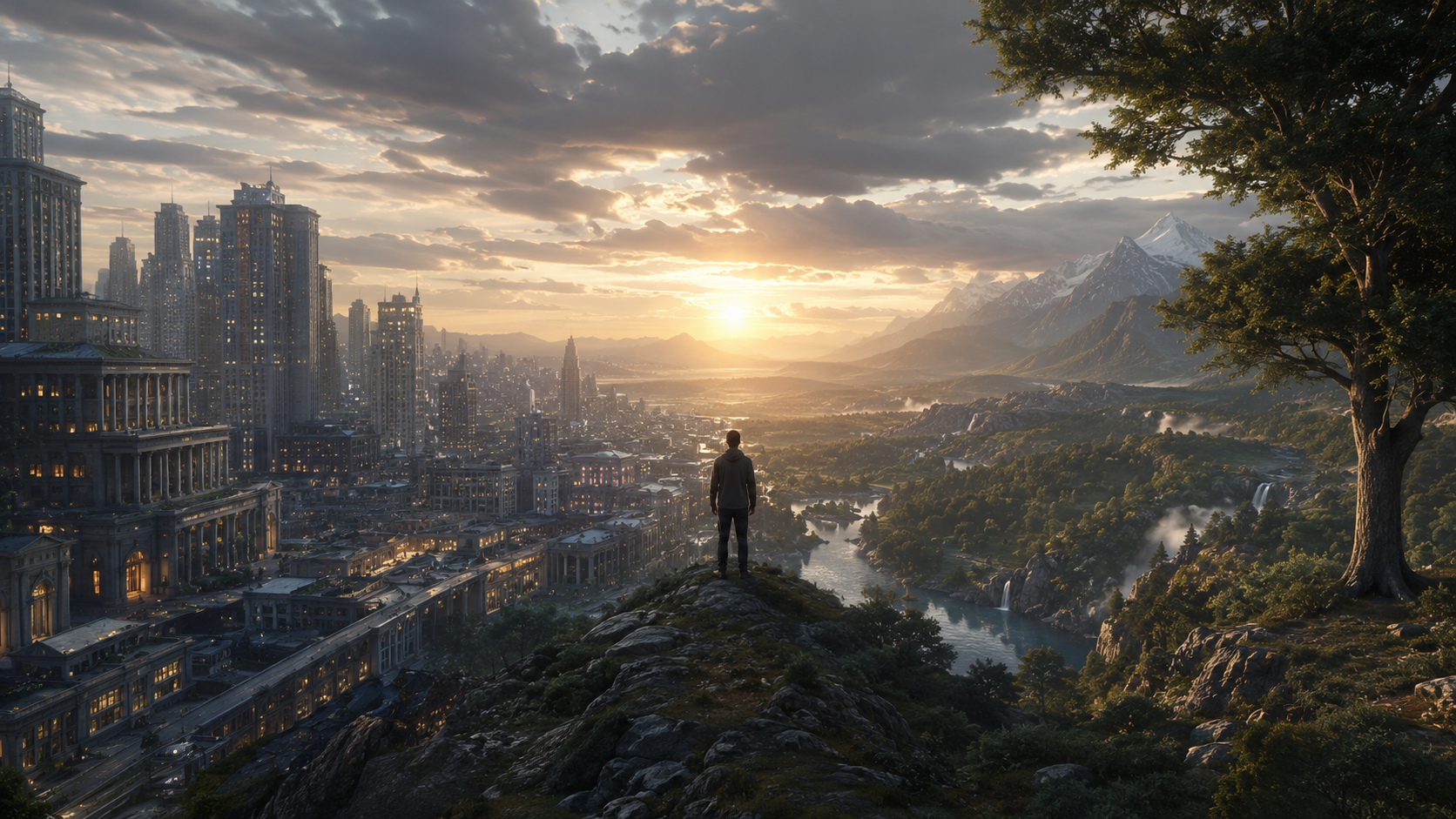
Does Human Progress Always Make Human Life Better?
Human history is often told as a story of progress. We look backward and see the development of agriculture, cities, science, industry, medicine, transportation, communication, and technology, and it is difficult not to recognize how dramatically these transformations have expanded human possibilities. People today can travel across continents in a matter of hours, communicate instantly with someone on the other side of the planet, access an enormous portion of humanity’s accumulated knowledge through a small electronic device, and benefit from medical treatments that would have seemed miraculous to previous generations. In material terms, civilization has achieved things that would have been almost impossible to imagine only a few centuries ago.
Yet progress is rarely as simple as the word itself suggests. Every major transformation solves certain problems while creating new ones, and some of those consequences may remain invisible for generations before becoming apparent. This does not mean that progress is inherently harmful, nor does it imply that humanity would be better served by returning to an earlier and more primitive way of life. Rather, it suggests something considerably more complicated: when human beings transform the world, they also transform themselves, and they do not always understand what those transformations are doing to them until much later.
The history of civilization repeatedly demonstrates this pattern. A technology can increase productivity while changing the nature of work. An institution can provide security while creating new forms of dependence. A communication system can connect millions of people while simultaneously altering the way individuals experience solitude, attention, friendship, and even reality itself. The central question, therefore, may not be whether progress is good or bad, but whether we are sufficiently capable of recognizing its unintended consequences before they become deeply embedded in our lives.
The Industrial Revolution and the Price of Greater Productivity
The Industrial Revolution provides one of the clearest examples of this paradox. Industrialization transformed the productive capacity of human societies on an extraordinary scale. Mechanization, specialization, factories, improved transportation, and technological innovation allowed goods to be produced in quantities that traditional forms of production could not approach. Over time, economic growth and increasing productivity contributed to profound improvements in material living standards, helping make products and services that had once been available only to relatively small portions of society progressively more accessible.
From an economic perspective, thinkers such as Ludwig von Mises emphasized the importance of productivity, capital accumulation, division of labor, and the expansion of economic cooperation in improving human material conditions. The industrial transformation was therefore not simply a story of exploitation or suffering; it was also one of the most important transformations in humanity’s ability to produce wealth and improve the conditions of everyday life.
At the same time, the early industrial period also exposed workers to extraordinarily difficult conditions in many places. Long working hours, dangerous factories, inadequate sanitation, workplace accidents, child labor, and extremely low bargaining power were realities experienced by large numbers of workers during different stages of industrialization. Social critics, including Karl Marx, devoted substantial attention to these conditions and attempted to explain the economic and social structures that produced them.
But recognizing these historical problems does not require us to conclude that industrialization itself was a mistake. The existence of exploitation during the Industrial Revolution does not mean that humanity would have been better off without industrial development, just as the existence of environmental problems associated with modern technology does not automatically mean that technological civilization should be abandoned.
The more interesting historical lesson is that a transformation can generate enormous benefits while simultaneously creating problems that require new forms of social adaptation, regulation, and moral reflection. Progress does not eliminate the need for judgment. In many cases, it makes judgment even more important.
Progress Does Not Eliminate Human Problems — It Changes Them
A similar pattern can be observed in the development of modern social welfare systems. In late nineteenth-century Germany, Otto von Bismarck’s government introduced pioneering forms of state social insurance designed to provide protection against problems such as sickness, workplace accidents, and old age. These institutions represented a significant change in the relationship between individuals, society, and the state, and they addressed genuine forms of insecurity that affected large portions of the population.
There are obvious benefits in creating mechanisms capable of protecting people against circumstances that can otherwise destroy their economic stability. Illness, disability, workplace injuries, and old age can impose burdens that individuals are not always capable of managing alone, and the development of social insurance represented an important institutional response to these realities.
Yet once again, the story does not end with the benefits. Expanding the state’s responsibility for economic and social security inevitably raises questions about individual autonomy, family structures, incentives, dependency, taxation, and the proper limits of government responsibility. Different political and economic traditions have interpreted these consequences differently, and reasonable people can disagree about where those boundaries should be established.
The important point is not to declare social welfare either good or evil. It is to recognize that institutions have consequences beyond their original intentions. A system designed to protect people can change behavior. A policy created to solve one problem can create another. A measure introduced as temporary can become permanent. An institution established to provide security can gradually reshape people’s expectations about responsibility and dependence.
This is one of the most important lessons of history: solving a problem does not necessarily mean eliminating complexity; sometimes it simply moves the complexity somewhere else.
The Digital Revolution May Be Doing Something Similar
This historical pattern becomes particularly interesting when we examine the technological transformation occurring in our own time. The digital revolution has changed human existence at a speed that is difficult to compare with most previous periods of history. Smartphones, social media, artificial intelligence, streaming platforms, search engines, and instant communication have placed an extraordinary amount of information and connectivity within reach of ordinary individuals.
There are genuine benefits here that should not be minimized. A person can communicate with relatives thousands of miles away, access educational material almost instantly, learn skills that once required expensive institutions, participate in communities that would otherwise be inaccessible, and obtain information about almost any subject imaginable. The smartphone, in particular, has effectively combined communication, navigation, entertainment, photography, education, banking, journalism, and countless other functions into a single device.
But perhaps we are still in the early stages of understanding what this technology is doing to human psychology.
The same technology that allows us to communicate constantly may make silence increasingly uncomfortable. The same platforms that give us access to millions of people may make it more difficult to give sustained attention to the few people physically present around us. The same device that allows us to explore the entire world may make it increasingly difficult to remain attentive to the small world immediately in front of us.
And perhaps the most important question is not whether technology is good or bad.
The deeper question is: what is technology doing to us?
When Connection Begins to Compete With Presence
Human beings have always searched for ways to communicate. Language, writing, letters, books, telephones, radio, television, and the internet each expanded the range through which human beings could share information and experience. Digital technology represents the most recent and perhaps most powerful stage of this process.
Yet communication and presence are not necessarily the same thing.
A person can be connected to hundreds of people online while experiencing profound loneliness. A family can sit together in the same room while each member is psychologically absorbed in a different digital environment. Friends can exchange messages throughout an entire day while having fewer meaningful conversations than previous generations might have had in a single evening.
The problem is not that digital communication is inherently inferior. It is that human attention is limited, and every technology competes for a portion of that attention.
When an individual spends hours moving rapidly between notifications, videos, messages, headlines, advertisements, and social media posts, the issue may not simply be the amount of information being consumed. It may also be the way the mind is being trained to consume information.
Instead of remaining with one idea, we move to another. Instead of tolerating boredom, we eliminate it. Instead of allowing silence to emerge naturally, we fill it. Instead of observing the environment around us, we document it. Instead of experiencing an event directly, we may immediately begin thinking about how it will appear on a screen.
This does not necessarily mean that technology is destroying attention. The reality is more complicated than that. But it does suggest that the tools we repeatedly use can influence the habits through which we experience the world.
And this brings us to a deeper question about something that existed long before smartphones: nature.
Nature as a Reminder of What It Means to Be Human
Long before modern psychology and digital technology existed, Aristotle observed that human beings are social creatures whose lives naturally unfold within communities. For Aristotle, human beings were not simply isolated individuals pursuing private desires; they were beings whose capacities developed through relationships, institutions, shared practices, and participation in a larger social world.
At the same time, human beings remain biological creatures. We eat, sleep, grow, experience pleasure and pain, perceive our surroundings, form attachments, experience desire, and respond emotionally to the world around us. What distinguishes human beings, in Aristotle’s account, is not that we cease to belong to the natural world, but that we possess rational capacities through which we can understand, deliberate, judge, and consciously direct our actions.
This creates a fascinating relationship between humanity and nature.
We do not merely inhabit nature.
We interpret it.
A bird builds a nest according to its instincts and biological capacities. Human beings observe structures in nature and can transform those observations into architecture. We see movement and rhythm in the natural world and transform them into music. We observe patterns, proportions, colors, and forms and reproduce them in painting, sculpture, engineering, mathematics, and design.
A simple natural structure can become the inspiration for an extraordinary human creation. A bird’s nest is an object of biological necessity, while a human architect can observe structures in nature and eventually construct cathedrals, bridges, palaces, and entire cities. The transformation from observation to creation is one of the clearest expressions of human intelligence.
The human being receives the world and gives it new form.
Why Do We Find Nature Beautiful?
There is another dimension to this relationship that is easy to overlook.
Human beings do not simply use nature.
We contemplate it.
A forest may be materially understood as an ecosystem composed of trees, plants, animals, microorganisms, soil, water, and countless interacting processes. Yet human beings can also stand within that forest and experience something that cannot be reduced to its biological components. We can perceive beauty, contemplate complexity, experience wonder, create poetry, paint landscapes, compose music, develop philosophical reflections, or simply remain silent while observing the environment around us.
A river is physically water moving through a landscape, but it can also become a symbol in literature, a subject in painting, an inspiration for music, or a spiritual image representing time, change, life, and mortality.
This capacity for contemplation is important because it demonstrates something essential about human nature. We do not merely encounter reality as a collection of objects that can be consumed or manipulated. We are capable of encountering reality as something meaningful.
And perhaps this is one of the reasons why our increasingly artificial environments deserve greater reflection.
The Paradox of Modern Civilization
The paradox of modern civilization is that the more successfully we have learned to protect ourselves from the natural environment, the less frequently we may encounter it directly.
Modern technology allows us to regulate temperature, illuminate darkness, travel enormous distances, communicate without physical proximity, obtain food without cultivating it ourselves, and entertain ourselves without leaving our homes. These achievements are remarkable, and there is no reason to romanticize the hardships of premodern life. Human beings have always suffered from disease, hunger, extreme weather, physical danger, and material scarcity, and technological progress has helped reduce many of these problems.
But there may be a psychological cost to living increasingly detached from the conditions that shaped human existence for thousands of years.
We spend enormous amounts of time indoors. We move between artificial environments. We interact with screens. We receive information through algorithms. We experience distant events through images and videos rather than through direct contact. Even our understanding of other people is increasingly mediated by digital representations of their lives.
In other words, we are increasingly surrounded not only by technology, but by representations of reality.
And this raises a question that deserves serious attention: what happens to human perception when representation becomes more present in our lives than direct experience?
Perhaps We Need to Learn How to Look Again
The answer does not have to be a rejection of technology.
There is no compelling reason to believe that humanity should abandon modern civilization and return to a primitive existence. Technology has improved countless aspects of human life, and the ability to use reason to transform our environment is itself one of the extraordinary characteristics of humanity.
The challenge is not to reject progress.
The challenge is to remain capable of governing it.
If human beings are rational creatures, then technological development should ultimately remain subordinate to human flourishing rather than becoming an end in itself. A technology should not be considered successful merely because it is powerful, profitable, efficient, or widely adopted. We should also ask what habits it creates, what forms of attention it encourages, what relationships it changes, and what aspects of human experience it strengthens or weakens.
This is particularly important because technological systems do not merely respond to human behavior. They can also shape it.
The tools we repeatedly use become part of our environment, and environments influence habits. Habits influence character. Character influences how we experience the world.
That means the question of technological progress is ultimately also a question about human formation.
Progress Should Expand Human Freedom, Not Replace It
The greatest danger of progress may not be that technology becomes powerful.
It may be that human beings become increasingly unable to live without it.
There is an important difference between using a tool because it makes life easier and becoming psychologically dependent upon that tool to experience ordinary life. A person who uses a smartphone to communicate has gained a useful capacity. A person who becomes unable to tolerate five minutes without checking the device has acquired a dependency.
The distinction matters because progress should ideally expand the range of things human beings are capable of doing, not reduce their capacity to function without the systems they have created.
A genuinely flourishing human life should still contain silence, conversation, solitude, friendship, contemplation, physical movement, contact with nature, intellectual curiosity, and direct experience. These things are not obsolete simply because technology has made other forms of experience more convenient.
Perhaps the goal of civilization should not be to eliminate every inconvenience.
Perhaps some inconveniences are precisely what keep us human.
Walking instead of driving occasionally, sitting quietly without entertainment, speaking to another person without simultaneously checking a phone, reading an entire book without interruption, spending time outdoors without documenting it, or simply watching the sky change at the end of the day may appear insignificant when compared with the extraordinary achievements of modern technology.
Yet these experiences remind us that human life is not merely a problem to be solved through greater efficiency.
Sometimes life is something to be experienced.
What History Can Teach Us About the Future
The Industrial Revolution changed how human beings worked. Modern social institutions changed how societies responded to illness, poverty, accidents, and old age. The digital revolution is changing how human beings communicate, consume information, form relationships, and perceive reality.
None of these transformations can be reduced to a simple narrative of good or evil.
Industrialization generated enormous wealth while producing serious social problems that demanded reform. Modern social insurance provided protection against genuine risks while generating continuing debates about autonomy, responsibility, and the role of the state. Digital technology has created unprecedented access to information and communication while simultaneously raising difficult questions about attention, dependency, loneliness, privacy, and the nature of human interaction.
The lesson is not that we should stop progressing.
The lesson is that progress requires wisdom.
Every generation inherits technologies and institutions created by previous generations, but it also inherits their unresolved consequences. Our responsibility is therefore not simply to ask what new things we can create. We must also ask what kind of human beings those creations will encourage us to become.
Because civilization is not only the transformation of the external world.
It is also the transformation of the human being who lives within that world.
Final Thoughts
Humanity possesses an extraordinary capacity to transform its environment. We can build cities, construct machines, compose symphonies, develop medicines, cross oceans, communicate across continents, explore space, and create technologies capable of changing the lives of billions of people. This ability is one of the clearest expressions of human intelligence, creativity, and freedom.
But precisely because we possess such extraordinary power, we also possess an extraordinary responsibility.
Progress should not be judged exclusively by what it allows us to accomplish. We should also judge it by what it does to our attention, our relationships, our character, our freedom, and our ability to experience the world directly.
The history of human civilization suggests that every great transformation carries consequences that its creators cannot completely predict. Some of those consequences will be beneficial; others will require correction. The important thing is to remain sufficiently conscious of the process to recognize when a tool designed to serve human beings begins to shape human beings in ways they never intended.
Perhaps we therefore need a broader definition of progress.
Progress should not mean simply moving forward.
It should mean moving forward without forgetting what is worth preserving.
We can embrace technology without allowing it to replace nature. We can value efficiency without treating every moment of life as something that must be optimized. We can communicate with the entire world without forgetting the people standing beside us. We can build increasingly sophisticated artificial environments without forgetting that we remain biological, emotional, social, and rational creatures who still need silence, beauty, contemplation, friendship, and direct contact with reality.
The human being can transform nature through reason, but cannot completely separate himself from nature without risking the loss of something essential about himself.
Perhaps, then, the real challenge of modern civilization is not learning how to progress.
We already know how to do that.
The real challenge is learning how to progress without losing ourselves along the way.
Leave a Reply