
Why Do Different Cultures Tell Similar Stories?
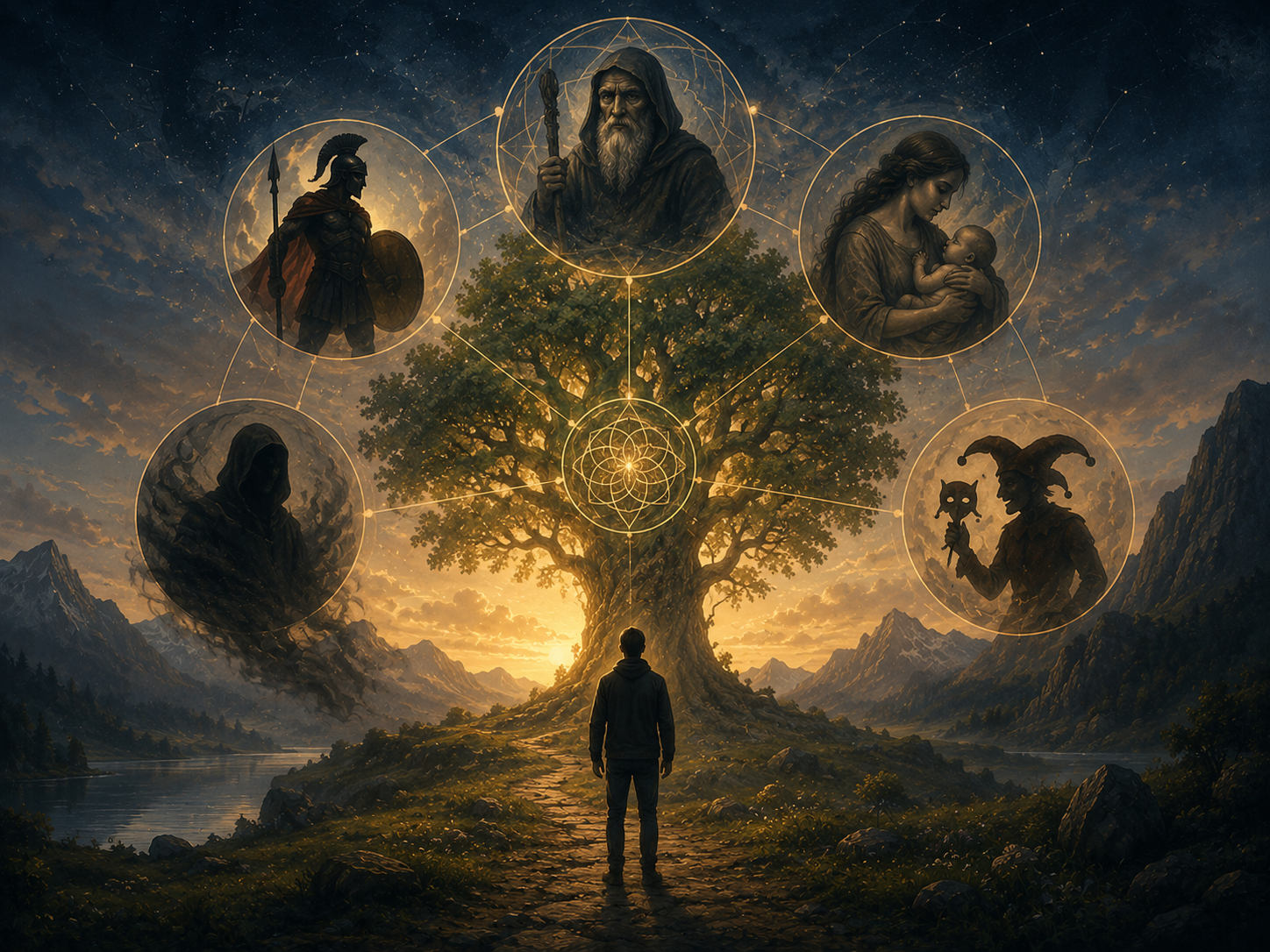
A hero begins a journey.
A wise mentor offers guidance.
A mother protects her child.
A villain embodies chaos.
These characters appear in myths, religions, novels, movies, and legends across the world.
But why?
How did cultures separated by oceans, languages, and centuries create such similar stories?
Carl Gustav Jung believed the answer could be found in something deep within the human psyche: archetypes.
According to Jung, there are universal patterns that influence how human beings think, feel, and interpret reality.
What Are Archetypes?
Archetypes are universal patterns of human experience.
They function as psychological structures that help organize the way we perceive the world.
Simply put:
Archetypes are fundamental ways of thinking, feeling, and acting that appear repeatedly throughout human history.
They are not specific characters.
They are patterns.
For example:
The Mother archetype is not your actual mother.
It is the universal pattern of care, protection, and nurturing.
The Hero archetype is not a particular fictional character.
It is the pattern of someone who faces challenges, grows, and transforms.
Where Do Archetypes Come From?
This was one of Jung’s most important questions.
He noticed similar symbols appearing in:
- Dreams
- Religions
- Myths
- Legends
- Works of art
- Spiritual experiences
Even among cultures that had never interacted.
To explain this phenomenon, Jung proposed the idea of the collective unconscious.
What Is the Collective Unconscious?
If the personal unconscious contains forgotten or repressed experiences, the collective unconscious is something deeper.
According to Jung, it is a universal layer of the psyche shared by all human beings.
Archetypes are the fundamental structures within this collective unconscious.
This is why certain symbols feel strangely familiar, even when we encounter them for the first time.
Are Archetypes Fixed Images?
No.
This is a common misunderstanding.
Jung did not believe that we inherit specific images.
Instead, we inherit psychological patterns.
The images come later.
For example, the Mother archetype may appear as:
- A biological mother
- A grandmother
- A religious figure
- Nature itself
- A fictional character
The form changes.
The pattern remains.
Jung’s Most Important Archetypes
Jung identified many archetypes, but several became especially influential.
The Hero
The Hero represents courage, growth, and transformation.
Heroes leave safety behind, face challenges, and return changed.
Examples include:
- Harry Potter
- Luke Skywalker
- Frodo Baggins
But it can also represent anyone trying to overcome personal struggles.
The Shadow
The Shadow represents the aspects of ourselves that we prefer not to see.
It may include:
- Fear
- Envy
- Anger
- Selfishness
- Repressed impulses
The Shadow is not necessarily evil.
It is simply the part of ourselves we tend to reject.
The Mother
The Mother represents nurturing, protection, and care.
It can appear in both positive and negative forms.
The protective mother and the controlling mother are different expressions of the same archetype.
The Wise Old Man
This archetype represents wisdom, guidance, and insight.
It often appears when the hero needs direction.
The Child
The Child represents potential, renewal, and possibility.
It symbolizes new beginnings and future growth.
How Do Archetypes Appear in Everyday Life?
Many people think archetypes exist only in myths and stories.
Jung disagreed.
He believed they appear constantly in everyday life.
They emerge through:
- Dreams
- Attractions
- Fears
- Role models
- Personal conflicts
Sometimes we react to people not because of who they are, but because of what they symbolize to us.
Do Archetypes Control Human Behavior?
Not exactly.
Jung did not view archetypes as fixed destinies.
They influence us.
But they do not determine our choices.
A better way to understand them is as deep psychological tendencies that shape how we interpret reality.
How we respond remains our responsibility.
Why Are Archetypes Important?
Archetypes help explain why certain symbols continue to resonate across generations and cultures.
They provide a framework for understanding:
- Inner conflicts
- Dreams
- Relationships
- The search for meaning
For Jung, learning to recognize these patterns was an important step toward greater self-understanding.
Final Thoughts
Archetypes remain one of Carl Jung’s most fascinating contributions to psychology.
They are universal patterns that appear repeatedly in myths, religions, dreams, and human experience itself.
We may debate Jung’s conclusions.
We may question his explanations.
Yet it is difficult to ignore how certain symbols seem to transcend cultures and generations.
Perhaps that is why humanity keeps telling the same stories.
And perhaps that is why those stories continue to tell us something about ourselves.
Leave a Reply